Shownotes
Did you know most people don’t understand palliative care—doctors included?
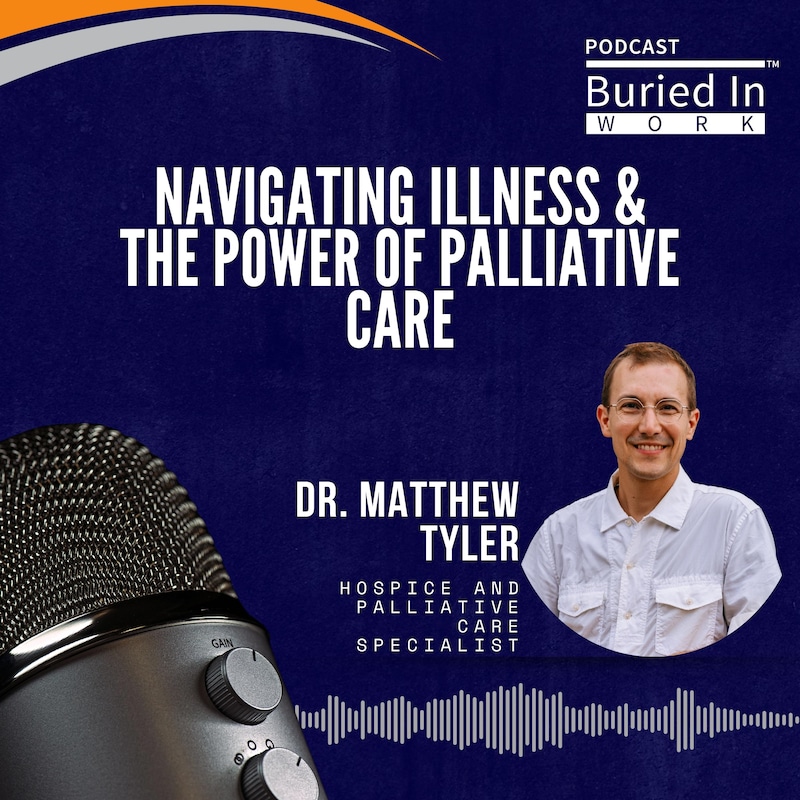
In this episode of Buried in Work, we sit down with Dr. Matthew Tyler, a hospice and palliative care specialist, to uncover the truth about palliative care—what it is, what it isn’t, and why it matters more than you think.
Dr. Tyler, the creator of How to Train Your Doctor, has made it his mission to empower patients and caregivers to take control of their healthcare decisions. With over 32,000 followers on Instagram, his insights are changing the way people approach serious illness, advocate for themselves, and navigate some of life’s toughest conversations.
Visit buriedinwork.com for the FULL SHOW NOTES
Transcripts
Adam: Speaking of controlling, oftentimes family members want to maintain a sense of control, especially if the individual that they're caring for is incapacitated or they have power of attorney or a variety of different family situations.
What tips can you offer them to help them advocate successfully for their loved ones?
Matthew Tyler: Well, I think as you're doing that healthcare power of attorney document, you know, don't just ask your spouse or child or sibling, hey, like, will you be my health care power of attorney?
Cool.
Make sure they understand your values and preferences and they have a general sense of where you would draw the line between living and just being alive.
So that way, when it, if ever they need to step up as your healthcare power of attorney, they have somewhat of a compass in terms of how to make decisions.
Try to do a little bit of prep work with their person they're naming to set them up for success.
Buried in Work Host: This is the Buried in Work podcast where we share tips and interview experts to help you simplify estate planning and end of life tasks.
Adam : Today we're joined by Dr. Matthew Tyler, who is a specialist in hospice and palliative medicine dedicated to helping patients with serious illnesses take control of their healthcare. He's the creator of How To Train Your Doctor.
If you're on Instagram, you very likely know him. He has more than 32 and a half thousand followers. And Matthew has set his life goal recently to empower patients and caregivers to confidently make decisions that are aligned with their values.
Matthew, we're thrilled to have you today on the show. Let's, let's get into it.
Matthew Tyler: Thanks so much for having me.
Adam : Yeah. All right, so let's start at the beginning. What inspired you to create How To Train Your Doctor? It's a phenomenal initiative.
Matthew Tyler: Yes, thank you for asking.
I think the inspiration for How To Train Your Doctor came about from a common theme I would see in my bedside practice. So for context, for most of my career as a physician, I've been working in a hospital as a palliative care consultant.
And the way that works is a primary care doctor or an oncologist or an intensivist comes to me and says, hey, like, I think this patient or family could really use your help.
Things are pretty serious. I need you to sit down with them and talk about symptom management or difficult decisions, and then I go and see them. The problem was very often I would hear about a patient through the grapevine, meaning like social worker, nurse trainee, and they'd say, you know what?
I really think this person could use your help. But the attending saying, like, they're not ready yet. You know, we're not there yet. And I would. I would just have to wait.
Meanwhile, a very common thing that I would hear from the patient and families after I met them for the first time, they would say, you're so helpful. Where have you been all this time?
We could have used you days, weeks, months, years ago.
And I got to thinking about this very tricky dynamic where palliative care is still not very well understood, both just in the general public or on the hospital side, the medical side.
A lot of doctors still associate palliative care with end of life care specifically, even though for years we've been clarifying that, you know, we're here to support you. Alongside illness treatment, you can get palliative care and chemotherapy, palliative care and rehab, physical, whatever you want.
But the association with palliative care and hospice has never really been fully broken. And many doctors still use palliative care in hospice synonymously.
Adam : Let's dig into that. So if someone's truly unfamiliar, what is the difference between palliative care and hospice care?
Matthew Tyler: Yeah, so palliative care is a medical specialty that focuses on providing support for anyone living with a serious illness. No matter what your prognosis is, no matter what treatment you're getting, palliative care care is there to help manage symptoms, help be a sounding board for difficult decisions that you're facing right now or difficult decisions you may be facing in the future.
We help coordinate your care, communicate, you know, between your doctors and making sure the doctors are talking to each other and that they're talking to you, and that basically you have all the information that you need to make decisions.
And we also do a healthy smattering of emotional support, psychosocial supports, spiritual support for those who. That is an important part of their quality of life. So that's palliative care.
Ultimately, the focus of palliative care is quality of life. And that is where palliative care and hospice are the same, that they both focus on providing people with support related to their quality of life.
The primary difference is that hospice care is specifically end of life care. Hospice care is for people who we believe to have six months or less in terms of time left to live.
And they are taking a focus on comfort measures only, meaning we're allowing this illness to run its natural course, and we just want to focus on comfort. And so that is sort of the niche that hospice fills.
Adam : Where does that Venn diagram live? So there has to be a little bit of overlap and A lot of people will go out and they'll find a company that will help them with hospice.
Are there companies specifically for palliative care, or is palliative care more of a vertical that doctors or others are?
How do you make that differentiation?
Matthew Tyler: Right. So in terms of, like, the graphic to think about as you think about palliative care versus hospice care, and often we use one that looks like kind of overlapping triangles.
So there's this classic overlapping wedges that's meant to symbolize palliative care support and illness support, meaning chemotherapy and palliative care. And they're overlapping to demonstrate that you can get them at the same time.
And as you kind of go forward, the role of disease focused treatment becomes less and less useful for people over time. And palliative care provides a more and more of a prominent role in your care until you get to a point where the disease focused treatment isn't helping at all.
And at that point, those triangles both sort of stop, and there's sort of this rectangle that represents hospice care to signify that once you're no longer benefiting from disease focused treatments, palliative care sort of steps aside and hospice care steps in.
For people who are looking to maximize support and comfort as their illness runs its natural course, who typically makes the.
Adam : Introduction to you or other palliative care providers? Is the doctor recommended? Is it on the role of the patient to recognize that they need it and then suggest it? What does that process look like?
Matthew Tyler: All the above. And this gets back to the original question about why I'm doing what I'm doing on social media, is that historically, it is at the discretion of the main doctor overseeing your care, Whether that's a primary care doctor or a cardiologist or an oncologist the onus has historically been on that doctor to look at you and your situation and say, hmm, you could really benefit from palliative care.
I'm gonna send a referral out.
However, historically and presently, there is still a tendency for that referral to come late, if ever at all. Regardless of how much you could benefit from palliative care, however, most doctors are open to patients asking for palliative care.
If the patient says, you know what? My quality of life has really taken a hit these past few months or year. I would like to see a palliative care team to see what they can do for me.
Most docs will say, sure, yeah, sounds good.
I had someone message me a few months ago saying that they brought it up to their oncologist saying, I could really benefit from a palliative care doctor. The oncologist said, oh yeah, I hadn't even thought about that.
But yeah, totally, I'll send the referral. It just doesn't, doesn't occur to them necessarily.
Adam : You listed off several different aspects of where palliative care can, can help out. From pain management to spirituality, everything in between. Is that what you mean by the palliative care team?
Matthew Tyler: Yes. Palliative care is at its core a team based sport and good high quality palliative care is thought of as interdisciplinary. Meaning you've got representation from physicians, nurses, social workers at minimum.
But what's available in your area is quite variable. And one of the challenges of providing high quality palliative care to everyone who needs it.
Adam : What are some of the other big challenges that patients are facing when they're interacting with their doctors and they're seeking palliative care?
Matthew Tyler: I think the main challenge tends to be mutual misunderstanding about palliative care.
Half the population has never even heard of it. So most of the public doesn't have a particular opinion one way or the other about palliative care. Meanwhile, on the doctor's side, most doctors are very confident that they know what palliative care is and they are, they're wrong because they associate it with end of life care.
So we've got a combination of just ignorance and confident incorrectness. So it's just not even recognizing that this need like has a, has a team that could address it.
So that tends to be the biggest barrier that I see day in and.
Adam : Day out and there enters How To Train Your Doctor. So let's talk a little bit about your approach and how you aim to address these challenges and make a dent. And you absolutely are.
And you see the engagement with your post is absolutely phenomenal. But let's talk about that a little bit. What's your approach?
Matthew Tyler: So my, I come from Missouri so I, so we, we call ourselves the show me State. And my, my approach on How To Train Your Doctor is really showing people what you get when you, when you have a palliative care doctor on your team.
And again I, I say doctor recognizing that it is an interdisciplinary team at its heart. But I'm a doctor and I teach what I know. But my hope by being on social media is just acknowledging that everyone's on social media and there's people talking about everything under the sun there already.
So I wanted to have little bite sized bits of information pertinent to palliative care that people could find wherever they're getting information normally, which tends to be the Internet. And this was my attempt at getting around the challenge that palliative care has, which is cleanly and quickly describing what we do.
As you saw, we've been talking for several minutes already and touching on the multiple facets of palliative care. But we struggle with our elevator pitch. Like, honestly, like everyone else has, you know, got a one sentence definition.
Cardiology, we're the heart guys. Nephrology, we're the kidney guys. Palliative care, we go into this like long winded explanation about multidisciplinary teams and quality of life and how you can get it alongside other treatments.
Like eyes start to glaze over and people start to tune out.
And I wanted just to get in there, start showing people what it is we talk about and they could decide for themselves if they needed it.
Adam : So what are some of those questions that you are helping people understand that they should be asking to make those informed choices?
Matthew Tyler: I'd say one of the most common ones is what we've talked about already, which is clarifying that people can get palliative care supports alongside illness treatment, whether that's cancer treatment, heart failure treatment, lung disease.
Just first and foremost making sure people know that they, you know, have, you know, they have a right to ask for this and it's not, they don't need to stop anything else to get palliative care.
That's a common one. The other common one is when people ought to be thinking about transition to hospice care and how to approach their medical team in a way that asks the questions in the right way to get honest and candid answers about what the doctors are thinking and what medical plan kind of makes the most sense for this person.
Adam : Many doctors, many different expertise. And there's the saying, you're unique, just like everybody else. And when individuals talk to their doctors, you never know how someone's going to react to a question.
Given that diversity of communication styles throughout the medical profession, and this happens in many professions, how do you advise people tailor that approach for the doctor that they're speaking to?
Are there tricks or tips?
Matthew Tyler: I think as you use that phrase, communication styles, I think this is where it's pertinent to clarify that doctors, we don't get communication training, so the communication style is basically whatever you saw, you're attending to in training.
And we just tend to mimic whatever our supervisor did for lack of an alternative.
And that's one of the biggest problems. And part of my platform is to empower patients to step into these conversations and just start having the conversation. Because doctors in medical school, we get a breaking bad news module and we get a very clumsy framework for delivering bad news.
But we don't get training in any way, shape or form about what to do after we deliver that bad news. We don't get training in putting together a medical plan that's centered on values that we start to get that training in palliative care fellowship.
But most doctors are not palliative care trained and yet are also having high stakes, emotionally charged conversations with their patients dealing with serious illness.
So part of what I try to emphasize is that just doctors don't have the training. It's not for like lack of them wanting to have conversations or caring about their patients.
They're just not trained in it. And the flip side is almost every doctor has a story about the time they tried to have a difficult conversation and it blew up in their face.
Because not every patient's ready to have these conversations.
We all come to these serious illness situations with a variety of coping skills and some coping skills are more developed than others. And almost every doctor is going to have some traumatic memory of the time they tried and it blew up in their face.
And it makes them very hesitant to re engage because they don't want to damage the therapeutic relationship or they don't want to damage trust, that trust that they've established with their patients or take away their hope.
And so I try to emphasize to folks on the platform that if it's important that you're having value centered conversations about your care, if it's important that your doctor is frank and honest about your chances and what they think is most likely to happen to you and what they think the most reasonable plan is, it can go a long way to start that conversation, even if it's.
I know it's a lot to ask of a patient who's dealing with so much already, but just starting that conversation can really do wonders for your plan.
Adam : Are you finding that it is the patient that typically starts that conversation? Is it the loved ones, the family members that are there to support them, that are finding out about palliative care and then pushing it in?
Or is there just no one way? There's no standard. It really can come from any direction.
Matthew Tyler: Tends to be a savvy caregiver for folks who are advocating for palliative care. Specifically, it tends to be someone who's in the medical field who knows that we exist and wants to meet with us.
Beyond that, the self advocacy, how I see a play out Tends to be either patients or family members or caregivers challenging the medical team on the point of what they're doing.
You might see this come out when medical team recommends another CAT scan or a biopsy, and the family might say, okay, but then what will we do with that? And the medical team will be like, I don't know, maybe we should talk to palliative care about that and that we kind of take it over from there.
Adam : And there's a lot that you cover, from DNRs to allergies and morphines to honesty versus hope.
Matthew Tyler: Yeah.
Adam : Are you finding that the audience are also in the medical field that are following you and engaging, so you're actually training the doctors yourself as opposed to the patients to train their doctors?
Matthew Tyler: Yes. And that was admittedly an unintended, unexpected but pleasant side effect of what I was doing.
The platform is built and geared towards people without a medical training, people who are not healthcare providers themselves, to help them understand how we think and how we speak and give people food for thought to bring to their care team.
But over these past years that I've been doing this, I have received a lot of comments, both publicly and privately from other people on healthcare teams just thanking me for what I'm doing and bringing this conversation to the public.
People will frequently message me or comment that they're going to use the language that I've used in this video and their own conversations, and then grateful to have that guidance.
Adam : Were there any specific videos that you made that resonated far better or had a more surprising impact than others? Like what sticks for you?
Matthew Tyler: Yeah, it's. It's become less guesswork, what's going to do well and what's not. I've certainly noticed that any conversations that I'm having about code status and CPR do not resuscitate.
People come with a lot of strong opinions about that.
And this notion that we should be so bold as to tell someone that they're dying, it doesn't, you know, there's strong opinions about this and I think that's what I, what I've learned is that, you know, healthcare is an interesting intersection of humanity and science.
And there comes a point where, strictly speaking in healthcare, something is or is not appropriate or indicated. But on, on the human side, it's not always that clean. But I, I'd certainly say that people tend to just engage when we talk about shaping and influencing end of life care in a healthcare setting.
There's a lot of mixed opinions about the role of a doctor in these conversations and our role as either just sort of a. A menu that you tap your choices on versus a guide or a counselor or just the person that' to do all the things.
And that's our role.
But I think it just goes to show that there's an important need to have a palliative care team that can recognize people come to serious situations with all different types of personal preferences that may shape how things play out.
And there's not necessarily a right or wrong answer there, but the value is in having that conversation to make sure that we are doing right by the person in front of us.
Adam : Have you evolved your approach personally, in.
Matthew Tyler: Healthcare or on social?
Adam : Both.
Matthew Tyler: I think, at the bedside. I've certainly being on social media and doing reels and forced to get a very complex thought down to 90 seconds or less.
I do feel like I can get to the point quicker at the bedside now. I can kind of encapsulate what's going on and summarize in a way that I'm a rambler by nature.
Again, I'm a Midwest guy. We don't. We don't say brevity is not our thing. But the routine exercise of trying to get a thought in every 90 seconds has certainly helped keep me a little bit short and sweet, but also still therapeutic and helpful for families.
On the social side, I think I've come to realize that. I think palliative care tends to be easiest to conceptualize when there is a specific question or problem that needs answering.
And I've constantly been working on the puzzle of, you know, how do we kind of map onto what the other specialists are already doing, right? There's a heart guy, there's a lung guy, there's kidney doc.
When palliative care sort of comes to the table saying, like, oh, just work on quality of life without a specific agenda, I think for a lot of people, they find that odd and hard to engage with us.
So I've noticed both at the bedside and on social, when we come in with a specific question like morphine's making me nauseous. What do I do next? Or, I want to live as long as possible, but I also want a comfortable death.
How do I build a plan around that?
When we come with questions and a focus to sort of be our rallying point, that tends to resonate both in video form and just at the bedside, too.
Adam : Do you think there's any instances where palliative care is just not something that even should come into the picture? Or is it when you hit a certain point, everybody should have it on their menu of options to go through.
Matthew Tyler: Yeah, I think yes, there is sort of a line, it's a nebulous one. And I think this is part of the problem with palliative care is a lack of access and B, a lack of a clear reference point.
Like what's the list of things that we get referred to palliative care for? Like that doesn't really exist. I think where things start to get nebulous is when you have a life altering diagnosis that's not necessarily terminal, meaning it's impacting your quality of life.
It's still, it's changing how you live and how you engage with the world and the people around you. But your prognosis may be years or decades.
I think the healthcare system doesn't really have an answer for this in general, to be honest.
And I think we try to, I think there's a tendency to try to throw palliative care and is the spackle to fix all, all cracks in the healthcare system which it just, it can't, it can't be that.
But I'd say chronic pain tends to be one that we have a harder time providing robust support around. Although many teams try their best to do that and if they're resourced to do that, that makes sense.
Beyond that, it's very seldom that we can't add value in some way as a palliative care team either by tweaking a symptom to be a little bit better controlled or providing some future facing guidance, meaning helping get directives in place like a healthcare power of attorney or a living will, or just clarifying the treatment plan now and getting people on the same page in terms of expectations that the patient has and making sure those are aligned up with their doctor's expectations too.
Adam : So what are some of those errors in the proverbial quiver to help you interact and address the concerns that are brought up? And then what are the metrics that you're tracking to see if it's actually making an impact?
Matthew Tyler: So there's, well, there's a, there's a lot there. So in terms of, you know, what we're doing at the bedside, I'll say a general needs assessment is typically starts with are there symptoms that are really out of control right now that we need to address first?
Because if there's severe pain in the mix, it's hard to have a real thoughtful conversation or kind of unpack the mysteries of the universe when you're just in agony. So I tend to triage severity of symptoms first beyond that, then we sort of dive into illness understanding, meaning do you have a sense of what's going on with your own body and how this is going to play out in the either hours, days, weeks, months or years ahead?
And if there is a, a knowledge gap between kind of what you know about your illness versus what the doctors know, you know, helping fill that in a way that's relevant to the patient's decision making needs.
And if that involves breaking bad news, provided the support alongside doing all that, and then beyond that, just kind of getting a sense of who's in your support network and how can we help them help you and what are your coping skills and how can we try to make those as robust as possible.
And if there's decisions to be made now, helping kind of coordinate the care around that. So often this might come in the form of a family meeting, meaning if someone's coming in with a pneumonia related to dementia, we might sit down and talk about what this means.
And that might include putting the primary team in front of this family along with a speech pathologist and talking about the progressive nature of dementia and what an aspiration pneumonia can mean for time so we can make a thoughtful decision about what comes next.
As far as metrics for tracking, if what we're doing is working, this is an, it's an interesting chapter in healthcare in general and that a lot of metrics have been more for us as healthcare providers and less for patients.
So kind of patient patient centered outcomes and kind of metrics as patients qualify them, we're starting to build more of awareness around the need to do that and track that meaningfully.
In terms of stuff that we track these days, it's a lot of it is just, you know, making sure that we are assessing for symptoms. The fact that we're assessing for a backup decision maker and giving people a chance to make a directive or chart their preferences in an advanced directive if they want to, and kind of making sure that we're consistent about what a general needs assessment looks like.
And then from there, kind of the whole goal of palliative care is always to make sure that patients are getting care consistent with the preferences and values. And how well we do that is a tricky one to measure as it's often it's hard to reconcile the fact that preferences and values will change over time and the fact that us as humans in general, we're very bad at predicting what we'll do or want in a future hypothetical scenario.
And so what I wrote down when I'm dying may not actually be what I choose to do when I'm dying, which is not necessarily a failure of advanced care planning or palliative care, but just how humans work.
And also a lot of these metrics tend to be gleaned from the survivors and the family caregivers after someone has died. And how the family feels about the quality of care may be different than how the patient feels.
And it's hard to reconcile that. But that's sort of where the work is right now.
Adam : Especially if you're trying to ask them to weigh in after somebody passes away in a time of grief. Their impression after something happens could be very different from what it was a week PR to things accelerating if they did.
Matthew Tyler: Yeah, yeah, yeah. But these days, practically speaking, I do the revolutionary thing where I just, I'll ask my patients, does any. Does this feel like the best plan for you right now?
And I'll have, you know, check ins on a, you know, every so often, depending on if they're in the hospital or in the clinic and how often a check in is needed.
But I will frequently emphasize with patients that I'm going to check in and make sure that this plan still makes sense. Not because I'm trying to change their mind, but because we're kind of here to make sure that whatever we're doing is, is on their own terms and that we're giving them as much control over a difficult situation as possible.
Acknowledging that control is a very low to term in these sorts of situations.
Adam : Yeah. Speaking of controlling, oftentimes family members want to maintain a sense of control, especially if the individual that they're caring for is incapacitated or they have power of attorney or a variety of different family situations.
What tips can you offer them to help them advocate successfully for their loved ones?
Matthew Tyler: Well, I think to a degree we try to encourage people to have conversations before they lose capacity. So some of this is preventative care, meaning as you're doing that healthcare power of attorney document, you know, don't just ask your spouse or child or sibling, hey, like, will you be my healthcare power attorney?
Cool.
Make sure they understand your values and preferences and they have a general sense of where you would draw the line between living and just being alive.
So that way, when it, if ever they need to step up as your healthcare power of attorney, they have somewhat of a compass in terms of how to make decisions.
Because I think we sort of downplay the fact that if you're stepping as a healthcare power attorney, like only bad things are happening, like there's no like, benign decision you're making.
As a healthcare power attorney, it's always about life support or CPR or feeding tube, like really, like really complicated, emotionally charged stuff for the most part. So I encourage people doing the directives to try to do a little bit of prep work with their person they're naming to set them up for success.
Beyond that, one thing that I frequently encourage my patients and caregivers to do is ask the doctors for recommendations and make sure they lead with what their priorities and values are.
So rather than just saying, what should I do, Doc? If you tell them, hey, look, like my brother always, you know, his independence was always very important to him. And he.
He told me he'd rather die than ever live in a nursing home. And if he needed people to care for him around the clock, you know, he wouldn't want to draw out his life beyond its natural course.
Based on that, Doc, what do you recommend I do at this point? And so that's often how I'll phrase things. You know, lead with the values, lead with the priorities, and then be explicit in your request for a recommendation based on that.
And I think that can really progress the conversation further than the normal.
Adam : I think that's great. Well, Dr. Tyler, thank you so much for sharing your insights on how to navigate serious illness and the powerful role that palliative care can play in enhancing quality of life.
If people want to find you, how can they get in touch and where can they find you? On Instagram.
Matthew Tyler: I'm on Instagram at How To Train Your Doctor. YouTube by the same name. And you can check out my website, howtotrainyourdoctor.com, where I've got a ton of resources there. And if you wanna work on me one on one, you can.
You can look me up there, too.
Adam : All right, and we'll make sure to get it in the show notes. Matt, I appreciate the time today. Thanks for the conversation.
Matthew Tyler: Thanks for having me.
Buried in Work Host: Thanks for listening to another episode of the Buried in Work podcast. Remember, you can save 10% on our estate preparation package and games with code PODCAST10 at buriedinwork.com.
